 English
 Português
Concretis: How modular shelters are redefining civil protection

By Eco Reflexus - 19/03/2026 - 0 comments
In recent years, the international context has highlighted a growing need to strengthen civil protection infrastructure. Geopolitical instability, armed conflicts in Europe, hybrid threats and extreme events have exposed weaknesses in the ability of cities and communities to respond to emergency scenarios.
Within this context, preparedness is no longer an abstract concept and has taken on a central role in risk management. The existence of physical protection solutions that are accessible, distributed and integrated into the territory has become a critical element in ensuring population safety.
The importance of accessible and distributed protection solutions
Across various international contexts, the implementation of protective shelters in urban areas has been observed, with the aim of ensuring rapid access to safe structures in emergency situations. This approach is already visible in real conflict scenarios, such as in Ukraine, where the presence of shelters accessible to the population has played a relevant role in responding to immediate risk situations. This approach is based on a simple principle. Proximity and immediate availability of shelter can make a difference in high-risk scenarios.
Unlike traditional bunkers, often associated with private or underground infrastructure, modern civil protection solutions aim to address a different logic. They must be:
Quick to install
Scalable
Integrated into the urban environment
Functional in everyday use
Architecturally discreet
It is within this context that solutions such as the Concretis line emerge, developed to meet current civil protection needs by combining structural robustness with implementation flexibility.
Concretis: A modular approach to civil protection
The Concretis range was created based on a resilient infrastructure logic, capable of being implemented across different territorial and operational contexts. Built on high-strength reinforced concrete modular structures, this solution was designed to withstand adverse conditions and provide protection in emergency scenarios.
The use of reinforced concrete ensures:
High resistance to pressure and direct impacts
Durability and low maintenance requirements
Structural stability across different environments
Long service life, even under demanding conditions
Beyond the structural component, modularity plays a central role. It allows each unit to be adapted to the specific needs of each location, both in terms of size and function.
Concretis Standard: Compact protection with rapid deployment

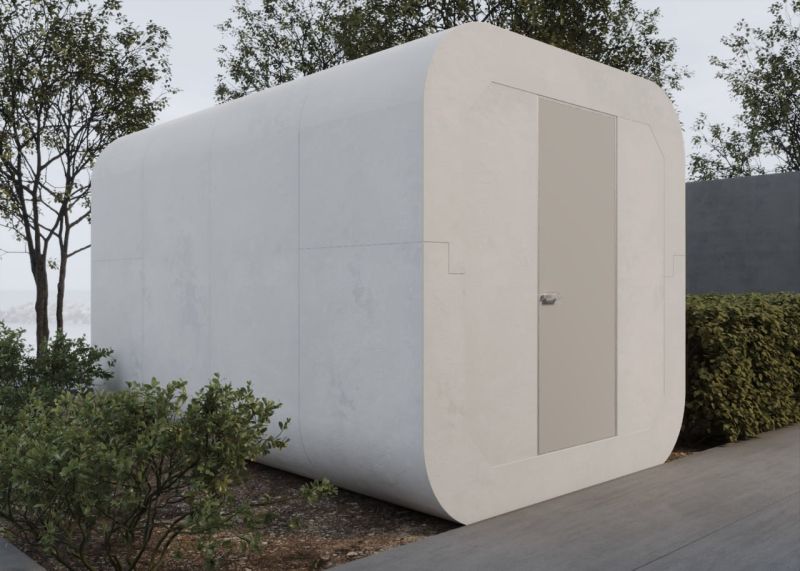
The Concretis Standard was developed as a compact solution, designed for scenarios where immediate protection is required with a reduced footprint.
Its main advantage lies in its ability to be installed in virtually any location. It can be integrated into urban areas, industrial zones, critical infrastructure or public spaces, functioning as an accessible protection point for small groups.
Its optimized dimensions allow:
Rapid implementation
Ease of transport and repositioning
Integration into spaces with physical constraints
Effective response in localized emergency scenarios
Additionally, it can be equipped with armored doors and CBRN filtration systems, increasing the level of protection in more demanding scenarios.
Concretis Community: Collective protection with increased capacity
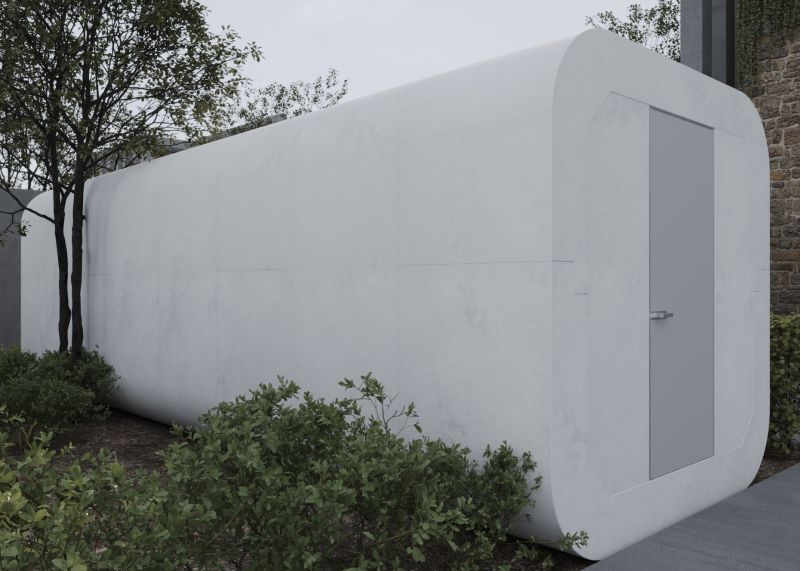
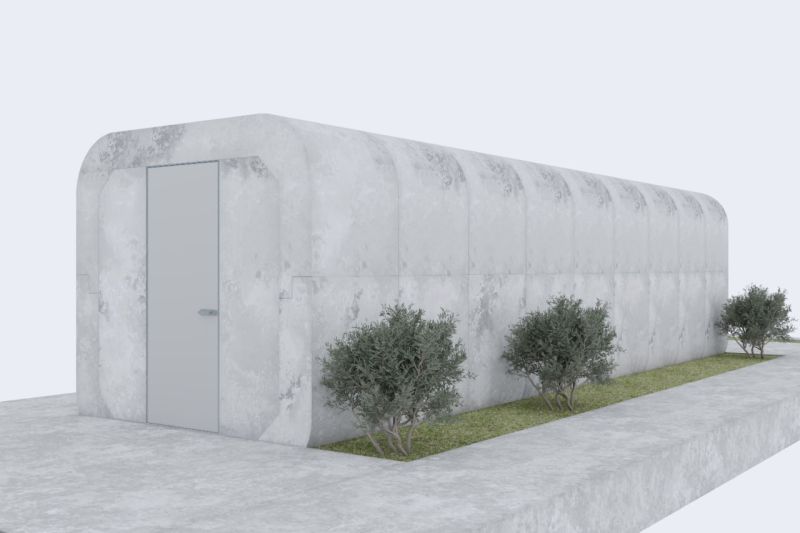
For contexts requiring greater response capacity, the Concretis Community model provides a collective protection solution.
With a double-module structure and increased usable volume, this model was designed to accommodate a larger number of people, making it particularly suitable for:
Residential communities
Public infrastructure
High-density urban areas
Critical logistical or operational zones
Its architecture allows not only greater capacity but also enhanced flexibility in adapting to the surrounding environment.
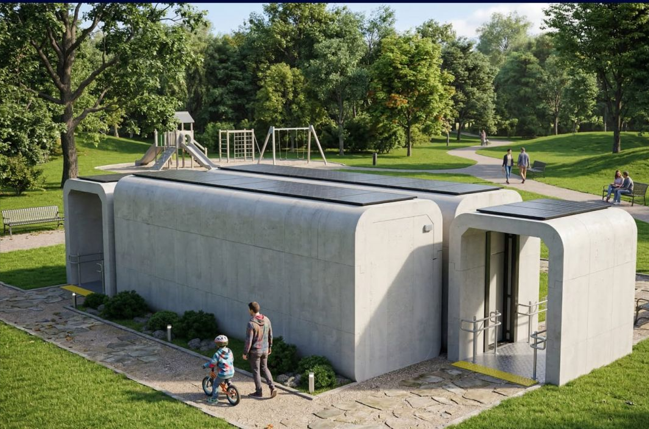
One of its distinctive features is its potential for functional integration. The shelter can take on different forms within the urban context, from mobility-support structures to elements of urban furniture, while remaining fully available for use in emergency situations.
Urban integration and operational discretion
One of the main challenges in implementing civil protection infrastructure in urban environments is its acceptance and integration into the space.
Concretis solutions were developed to address this challenge. The possibility of aesthetic and functional adaptation allows shelters to be discreetly integrated into the environment, without compromising the normal use of spaces.
This approach enables the transformation of emergency infrastructure into a permanent solution that is available, yet non-intrusive.
Preparedness as a pillar of resilience
Preparation for crisis scenarios does not depend solely on plans or protocols. It depends on the existence of concrete infrastructure capable of protecting people when needed.
Solutions such as the Concretis line represent an evolution in how civil protection is approached. It shifts from being reactive to becoming integrated, planned and territorially distributed.
In an increasingly uncertain global context, investing in protection infrastructure is not just a preventive measure. It is a strategic decision that contributes to the safety, continuity and resilience of communities and organizations.
Tags: Concretis