 English
 Português
Why survival foods with a 20-year shelf life make all the difference

By Eco Reflexus - 02/03/2026 - 0 comments
Most people associate preparedness with storing ordinary food. Canned goods, pasta, rice or tinned products seem like natural choices. However, this approach follows a daily consumption logic, not a survival one. In real emergency scenarios, such as natural disasters, prolonged crises or structural supply failures, the criteria change completely. Shelf life, energy density and ease of use become more important than price or taste.
It is precisely in this context that dedicated survival foods come in, such as NRG-5 Zero and NRG-5 Vegan. These products were specifically developed for long-term storage and immediate response, and have been used for decades in military kits, humanitarian operations and disaster zones. Unlike conventional foods, they are not an improvised adaptation. They are solutions designed from the ground up for extreme scenarios.
The structural problem of common foods in emergency kits
Traditional foods present several limitations when integrated into strategic reserves. The first is shelf life. Most household canned foods have a limited lifespan, usually only a few years, which forces constant rotation. This creates recurring costs and increases the risk of failure, especially in reserves that are not regularly monitored.
Another critical factor is logistics. Many conventional foods require preparation. They need water, heating or utensils. In a real crisis scenario, these resources may not be available. They also have low volumetric efficiency. They are heavier, take up more space and make both storage and evacuation more difficult.
In other words, although they seem like a simple solution, common foods introduce operational complexity precisely when simplicity is most needed.
What sets survival foods apart
Survival foods were developed with a completely different logic. The goal is not gastronomic consumption. It is to ensure stable nutrition for years or decades, without the need for maintenance or replacement.
Compact rations such as NRG-5 are a clear example of this philosophy. A 500-gram pack can provide around 2,300 kcal, enough to cover an adult’s daily energy needs. In addition, they offer a shelf life that can reach up to 20 years under proper storage conditions.
Another key point is ease of use. These foods are ready to eat, with no need for cooking or heating. Alternatively, they can be dissolved in water to create porridge or energy drinks, increasing versatility across different contexts.
The packaging itself is designed for longevity. It typically uses hermetic sealing and materials resistant to moisture and oxygen, ensuring nutritional stability over long periods.
NRG-5 Vegan and NRG-5 Zero
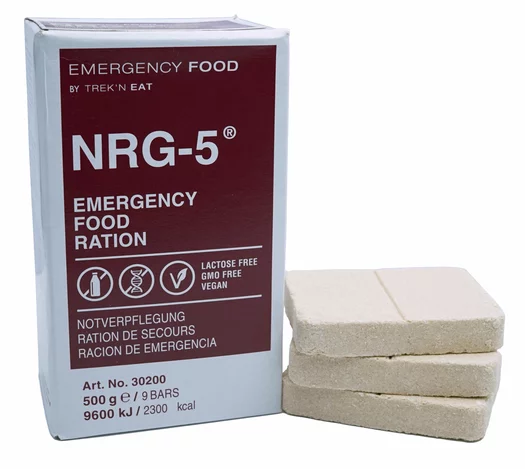
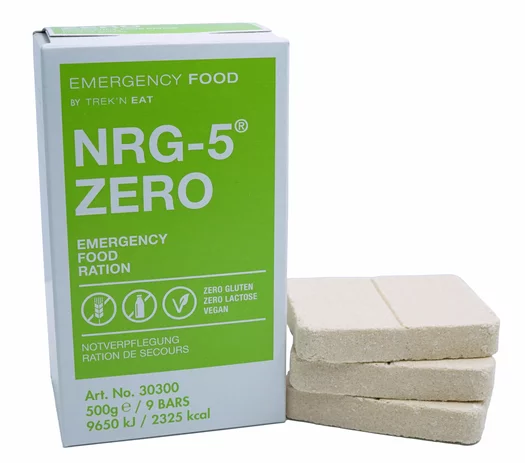
Within this category, there are two main variants with distinct profiles. NRG-5 Vegan follows the classic formula, based on cereals and plant protein, offering a balanced nutritional profile and a shelf life that can reach two decades.
NRG-5 Zero was developed to meet specific dietary needs. It is a gluten-free version, based on rice and plant protein, maintaining high caloric density and a minimum shelf life of around 15 years. It remains vegan, lactose-free and suitable for different dietary restrictions, making it particularly relevant in family or institutional kits.
Both versions share the same pillars: high energy density, compact storage and immediate consumption.
Why shelf life changes everything
Durability is probably the most underestimated factor in civil preparedness. A food with a 20-year shelf life is not just more durable. It completely changes the logic of preparedness.
First, it eliminates the need for frequent replacements. Instead of managing constant stock rotation, it becomes possible to build stable reserves for decades. Second, it drastically reduces the risk of operational failure. The probability of finding expired food at a critical moment drops significantly.
There is also a relevant economic impact. Despite a higher upfront cost, the absence of frequent replenishment lowers the total cost over time. Finally, there is a gain in predictability. Knowing that a food reserve remains viable for years creates confidence and stability in any preparedness plan.
Preparedness is not about stockpiling food. It is about choosing wisely
A common mistake in preparedness is confusing quantity with resilience. Having large volumes of ordinary food does not mean being prepared. In many cases, it simply means more logistics and a higher likelihood of failure.
True preparedness lies in selecting solutions designed for extreme scenarios. Products like NRG-5 Zero and NRG-5 Vegan exist precisely for that purpose. To provide compact, stable and predictable nutrition when normal supply chains stop functioning.
Because in the end, the most important question is not what you have in your pantry today.
It is what will still be usable in 10 or 20 years.