 English
 Português
EMP Protection & Faraday Cages
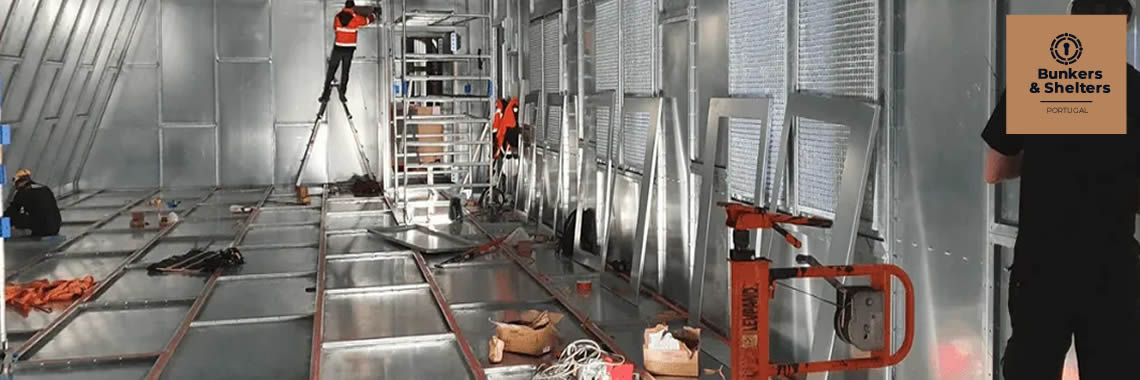
By Eco Reflexus - 29/09/2026 - 0 comments
We live surrounded by technology.
Communications, security systems, energy, computers, servers, medical equipment, control systems and many of the devices used every day depend on electronic components.
This dependence makes the protection of electronic equipment an important part of the resilience of certain homes, businesses and critical infrastructures.
Among the phenomena that can affect these systems are electromagnetic pulses, commonly known as EMPs, Electromagnetic Pulses.
But what exactly is an EMP? Which types of equipment can be affected? And how can a Faraday cage, a protected room or even a portable solution help reduce this vulnerability?
What is an EMP?
An electromagnetic pulse, EMP, is a short-duration electromagnetic disturbance capable of interacting with electrical and electronic systems.
There are different types and possible sources of electromagnetic disturbances.
One of the best-known concepts is HEMP, High-Altitude Electromagnetic Pulse, associated with a nuclear explosion at high altitude.
A HEMP is characterised by high-amplitude, short-duration components and can affect electrical and electronic systems over a wide area.
There is also IEMI, Intentional Electromagnetic Interference, which refers to the deliberate use of electromagnetic energy to interfere with equipment or systems.
Unlike a HEMP, which has broadband characteristics, certain IEMI sources may concentrate energy within a more limited frequency range.
Why can an EMP affect electronic equipment?
Electronic equipment operates through circuits designed to function within specific electrical limits.
A sufficiently intense electromagnetic disturbance can induce voltages and currents in components, cables and connected systems.
There are therefore two main pathways that should be considered in an EMP protection project:
Radiated electromagnetic energy, which can reach equipment directly through the electromagnetic field;
Conducted energy, which can enter a protected area through power cables, communications lines and other conductive connections.
This distinction is important because it means that an EMP protection solution should not be considered simply as a metal wall.
The entire installation must be taken into account.
Which systems may require EMP protection?
The relevance of protection always depends on the criticality of the equipment and the required level of resilience.
Systems where electromagnetic protection may be particularly important include:
- communication systems;
- data centres and servers;
- security equipment;
- control and automation systems;
- energy infrastructure;
- telecommunications;
- hospitals and healthcare facilities;
- water supply and treatment systems;
- financial infrastructure;
- transport systems;
- industrial facilities;
- emergency electronic equipment.
CISA and the U.S. Department of Energy include electromagnetic phenomena among the risks considered when assessing the resilience of certain critical infrastructures.
How does EMP protection work?
There is no single solution capable of addressing every scenario.
Protection is generally developed through a combination of complementary measures designed to limit the amount of electromagnetic energy that reaches protected equipment.
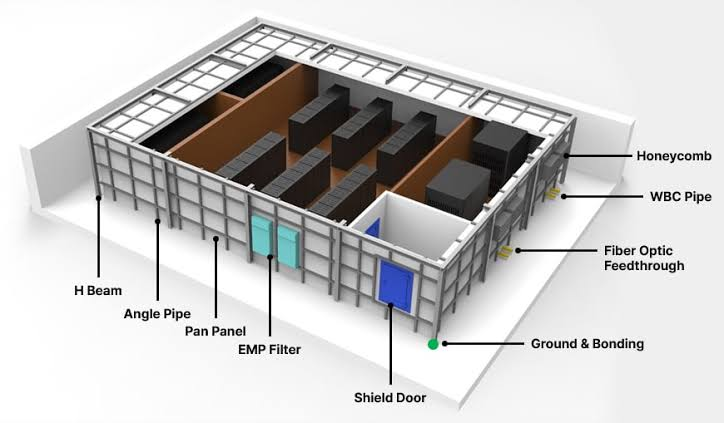
The main elements include electromagnetic shielding, protection of entry points, filtering, grounding and bonding, and control of the different penetrations through the protected barrier.
1. Faraday cage and electromagnetic shielding
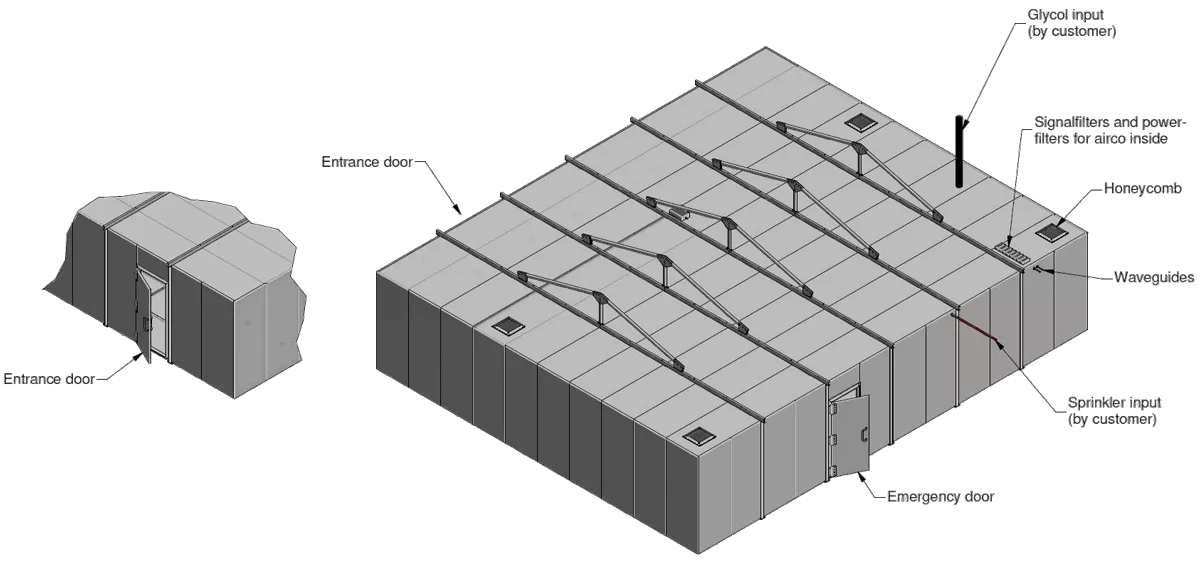
One of the best-known forms of protection is the Faraday cage.
The principle consists of creating an electrically conductive enclosure around the area or equipment that needs to be protected.
In high-requirement applications, this enclosure should maintain electrical continuity across the walls, ceiling, floor, joints and other interfaces.
MIL-STD-188-125-1, used as a reference for HEMP protection of certain critical ground-based military facilities, describes an electromagnetic barrier formed by a continuous conductive enclosure, with joints and seams electromagnetically sealed.
A Faraday cage should therefore be treated as a complete system rather than simply as a metallic covering.
2. Entry points are as important as the walls
A protected room normally requires doors, electricity, ventilation and, in many cases, communications.
Each of these connections represents a penetration through the electromagnetic barrier.
These are precisely the points that require particular attention in an EMP protection project.
A structure may have an effective metallic enclosure and still remain vulnerable if a cable penetration, door or opening is not correctly integrated into the overall protection system.
For this reason, a protected infrastructure should take into account elements such as:
- doors;
- power cables;
- communications;
- ventilation;
- pipes;
- joints;
- technical penetrations.
CISA also identifies barrier penetrations and their integration into the electromagnetic protection system as relevant elements of an EMP protection strategy.
3. Protection of power lines
Electricity is one of the main connections between a protected area and the outside environment.
For this reason, an EMP-protected installation may require specific solutions to limit conducted pulses travelling through electrical lines.
In high-protection environments, appropriate filtering and suppression systems may be used according to the type of threat and the electrical characteristics of the installation.
The HEMP protection architecture described in MIL-STD-188-125-1 also includes protection devices associated with the facility's points of entry.
4. Communications and data cables
The same principles apply to communications.
Network cables, telecommunications systems, sensors and other conductors that cross the protected barrier may provide potential entry paths.
For this reason, the design should seek to reduce and control these connections.
Where technically appropriate, connections that reduce electrical continuity between the exterior and protected equipment may also form part of the protection architecture.
5. Protected ventilation
A bunker, shelter or technical room cannot simply be sealed.
People and equipment require airflow.
Ventilation, however, creates an opening in the electromagnetic barrier.
Technical solutions are available that allow airflow while seeking to maintain the electromagnetic shielding performance of the protected area.
This example demonstrates why EMP protection should be considered from the early stages of the project.
6. Grounding and bonding
Electromagnetic protection also involves the way metallic components and electrical systems are connected to one another and to the grounding infrastructure.
CISA highlights the importance of a properly designed grounding system and of connecting the protection barrier to the facility's grounding system.
Bonding, meaning the creation of appropriate electrical connections between conductive elements, is also important for maintaining the continuity of the barrier.
Grounding, bonding and shielding should therefore be considered together.
EMP protection adapted to what you need to protect
One of the most important points is that it is not always necessary to protect an entire house, bunker or building.
The scale and level of protection can be adapted to what actually needs to be preserved.
At Portugal Bunkers & Shelters, electromagnetic protection can be considered at different scales, from small essential devices to complete protected rooms.
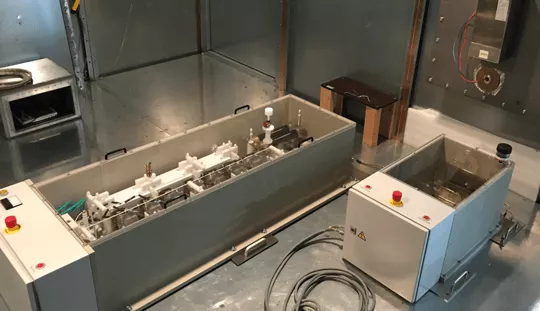
Faraday cases for essential assets
For users who only need to protect specific equipment, a compact solution may be sufficient.
A shielded case based on the Faraday cage principle can create a protected environment for storing selected equipment.
It may be suitable for assets such as:
- radios;
- communication devices;
- mobile phones;
- tablets;
- laptops;
- external drives and data-storage systems;
- emergency electronic equipment;
- small medical devices;
- spare electronic components.
The advantage of this concept is simple. Instead of protecting an entire room, protection is concentrated on the items considered essential.
It is also a portable solution, allowing protected equipment to be transported when required.
Custom Faraday tents
When a protective case is too small but a permanent protected room is not justified, an intermediate solution may be considered.
A Faraday tent uses electromagnetic shielding materials to create a larger protected space.
It can be sized and customised according to the intended application.
This type of solution may be considered for:
- IT equipment;
- servers;
- communication systems;
- technical equipment;
- temporary protected areas;
- equipment that needs to remain accessible;
- applications where a removable or portable solution is required.
The configuration should be adapted to the dimensions, access requirements, power supply, communications and operating requirements of the project.
Complete rooms with EMP protection
For more demanding requirements, a complete room with electromagnetic shielding can be created.
In this case, the room itself becomes the protective barrier.
Walls, floor and ceiling form the conductive enclosure, while doors, ventilation, power, communications and other penetrations are integrated into the design.
This approach may be particularly relevant for:
- bunkers;
- shelters;
- safe rooms;
- technical rooms;
- communication centres;
- server rooms;
- control centres;
- business facilities;
- critical infrastructure.
The main advantage is the ability to keep several systems inside a single protected area.
EMP protection integrated into a bunker
In a modern bunker, many of the systems required for autonomy depend on electronics.
These can include:
- communications;
- ventilation systems;
- sensors;
- CCTV;
- access control;
- energy storage;
- electrical management;
- monitoring equipment;
- IT systems.
For this reason, electromagnetic protection can be considered from the project-design stage alongside other protection systems.
Integrating it from the beginning makes it easier to coordinate the shielding with the bunker structure, doors, ventilation, power supply and communications.
Depending on the user's requirements, the protection may cover only selected equipment or an entire technical area.
Should EMP protection be tested?
Yes, when a defined level of performance is required.
It is not sufficient to assume that a structure functions as a Faraday cage simply because it is made of metal.
Joints, doors, cables, ventilation and other discontinuities can significantly affect the performance of the installation.
For this reason, installations with specific requirements may be subjected to shielding-effectiveness tests and testing of the different entry paths.
MIL-STD-188-125-1 includes specific testing and verification requirements for facilities covered by the standard, including procedures related to shielding effectiveness and pulsed-current injection.
The level of testing required will, however, depend on the purpose and requirements of each installation.
EMP protection is more than just a Faraday cage
A Faraday cage is a fundamental component of many electromagnetic protection solutions.
However, the protection of a complete infrastructure is more comprehensive.
It is necessary to consider, at the same time:
- the shielding enclosure;
- doors and joints;
- power lines;
- communications cables;
- ventilation;
- pipes and other penetrations;
- grounding and bonding;
- installed equipment;
- maintenance of protection continuity;
- testing and validation.
It is the combination of these elements that allows a coherent protection system to be developed.
Custom EMP protection solutions
No two requirements are exactly the same.
A family may only want to preserve communications and essential electronic equipment.
A company may need to protect servers or control systems.
A critical infrastructure may require multiple systems to remain available.
For this reason, Portugal Bunkers & Shelters can assess EMP protection solutions adapted to the required level of protection and the scale of each project, including:
- Faraday cases for essential assets and equipment;
- custom Faraday tents;
- complete rooms with electromagnetic shielding;
- EMP protection integrated into bunkers, shelters and safe rooms;
- protection of technical rooms and critical equipment.
The first step is to identify what genuinely needs to remain protected and operational.
From there, the dimensions of the protected area, required access points, external connections and appropriate technical solution can be defined.
Would you like to integrate EMP protection into your project?
Electromagnetic protection should be designed according to the equipment, infrastructure and required level of resilience.
Portugal Bunkers & Shelters develops customised protection and engineering solutions for residential, commercial and specialist infrastructure projects.
From protecting small essential electronic devices to creating a complete Faraday room integrated into a bunker or technical installation, each solution can be developed according to the specific requirements of the project.
Contact Portugal Bunkers & Shelters to assess the EMP protection requirements of your project